
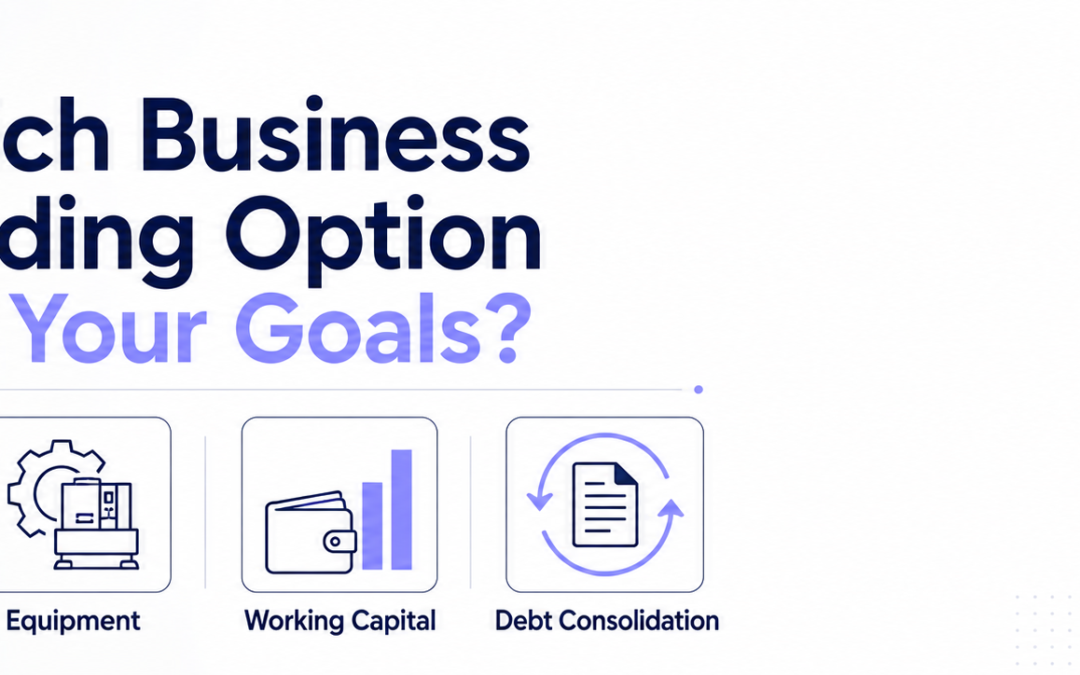
Choosing business funding is not only about how much capital you can access. It is also about selecting a funding structure that matches what your business needs to accomplish.
A company preparing to expand may need a different solution than one purchasing equipment, improving short-term cash flow, or consolidating existing obligations. Each purpose has its own timeline, expected return, and repayment considerations.
Before comparing offers, start with one basic question:
What does the funding need to accomplish for the business?
Once the purpose is clear, it becomes easier to evaluate which business funding options may be appropriate.
Why the Purpose of the Funding Matters
Different business goals require different financial strategies.
Long-term investments may benefit from longer repayment periods. Short-term operating needs may require more flexibility. Equipment purchases may call for financing that is connected directly to the asset being purchased.
Selecting funding without considering its purpose can create unnecessary pressure on cash flow. A business may receive the capital it needs but still struggle if the repayment structure does not match the expected return.
A practical funding decision should consider:
- How the funds will be used
- How quickly the investment may produce value
- How much monthly payment the business can reasonably manage
- Whether the need is short term or long term
- How the new obligation may affect existing cash flow
The right option is not always the fastest option. It is the option that supports the business goal without creating an avoidable financial burden.
SBA Loans for Long-Term Business Goals
SBA loans may be worth considering when a business needs funding for a significant or long-term purpose.
Depending on the available program and the applicant’s qualifications, SBA financing may be used for goals such as:
- Business expansion
- Purchasing an existing business
- Acquiring commercial real estate
- Refinancing eligible business debt
- Purchasing equipment
- Supporting working capital needs
One of the main reasons business owners explore SBA loans is the potential for a longer repayment structure compared with many short-term funding products. A longer term may help reduce monthly payment pressure, although eligibility, terms, and program availability vary.
SBA financing is not the right fit for every situation. The process may require more documentation, and approval is based on factors such as business performance, credit profile, cash flow, and the purpose of the funds.
For established businesses with a clear long-term plan, an SBA loan may provide a more structured path to growth.
Working Capital Financing for Day-to-Day Needs
Working capital financing is generally used to support regular business operations.
A business may use working capital for:
- Payroll
- Inventory
- Marketing
- Seasonal expenses
- Supplier payments
- Temporary cash flow gaps
- General operating costs
This type of funding may be appropriate when the business needs flexibility rather than financing for one specific asset.
The repayment structure should still be reviewed carefully. Business owners should understand how frequently payments are made, the total repayment amount, and how the obligation may affect daily or monthly cash flow.
Working capital can provide useful support, but it should be connected to a clear operational purpose. Using short-term capital without a repayment plan may create additional pressure rather than solving the original problem.
Equipment Financing for Business Assets
Equipment financing is designed to help businesses purchase the tools, machinery, vehicles, technology, or other assets needed to operate.
This option may be appropriate for businesses that need to:
- Replace outdated equipment
- Increase production capacity
- Upgrade technology
- Purchase specialized machinery
- Add vehicles or operational assets
Equipment financing can help a business preserve cash instead of paying the full purchase price upfront.
Because the financing is tied to a specific asset, it is often easier to measure the value of the investment. Business owners can compare the cost of the financing with the revenue, efficiency, or capacity the equipment is expected to produce.
Before moving forward, consider the useful life of the equipment. The repayment period should make sense in relation to how long the asset is expected to remain productive.
Debt Consolidation and Refinancing
Some businesses carry several loans, advances, or other obligations with different payment schedules.
When daily, weekly, or monthly payments begin to stack up, cash flow can become difficult to manage. Debt consolidation or refinancing may help eligible businesses combine certain obligations into a more manageable structure.
The potential goals may include:
- Reducing payment frequency
- Lowering monthly payment pressure
- Improving cash flow visibility
- Replacing short-term obligations with a longer-term structure
- Simplifying several payments into one
Consolidation does not automatically mean that every obligation will qualify or that the total cost will be lower. Business owners should review the complete terms, including the repayment period, total payback, fees, and any existing balances that must be resolved.
The purpose of consolidation should be to improve the financial structure of the business, not simply delay an existing problem.
How to Compare Business Funding Options
Once the purpose is clear, compare each available option using the same set of questions.
1. What is the total cost?
Do not evaluate an offer based only on the payment amount. Review the total repayment obligation, fees, interest, and other costs.
2. How often are payments required?
Payments may be structured daily, weekly, or monthly. The frequency can have a significant effect on cash flow.
3. How long is the repayment period?
A longer term may reduce the payment amount, but it may also change the total cost. The term should match the expected value and timeline of the investment.
4. What documentation is required?
Some funding options require more financial information than others. Be prepared to provide items such as bank statements, tax returns, financial statements, debt schedules, and business documentation.
5. Does the payment fit the business cash flow?
A funding option should support the business rather than create a payment that is difficult to maintain.
6. Is the funding amount appropriate?
Borrowing more than necessary can increase costs. Borrowing too little may leave the business unable to complete the intended project.
Common Business Funding Mistakes
One common mistake is choosing an option based only on speed.
Fast access to capital can be useful, but speed should not replace proper evaluation. A quick solution with frequent payments may not be appropriate for a long-term project.
Another mistake is focusing only on the payment amount. A lower payment may appear attractive, but the full repayment period and total cost still matter.
Business owners should also avoid using funding without a specific plan. Capital should be connected to a defined purpose, expected outcome, and repayment strategy.
Finally, businesses should compare more than one available option whenever possible. A single offer does not always provide enough information to determine what is appropriate.
Matching Funding to the Business Goal
A simple way to begin is to match the purpose with the category of funding that may be relevant.
- Expansion: SBA loan or other long-term business funding
- Equipment purchase: Equipment financing
- Working capital: Working capital program or business funding
- Debt consolidation: Consolidation or refinancing option
These categories are starting points, not guarantees. The best fit depends on the business profile, financial condition, eligibility, and specific use of funds.
How Diverse Merchant Solutions Can Help
Diverse Merchant Solutions helps business owners review practical funding options based on their needs and goals.
DMS is not a direct lender. As an authorized broker, DMS helps clients explore programs from multiple providers rather than being limited to one funding source.
The process begins with understanding the purpose of the funding, the financial condition of the business, and the payment structure the business can reasonably support.
Whether the goal is expansion, working capital, equipment financing, or debt consolidation, the objective is to identify options that make sense for the business rather than simply selecting the fastest available offer.
Review Your Business Funding Options
The right funding decision begins with a clear purpose.
Before applying, define what the capital needs to accomplish, how quickly it should create value, and what repayment structure the business can support.
Diverse Merchant Solutions can help you review available programs and determine which options may fit your business goals.
Apply Now:
https://www.diversemerchantsolutions.com/apply-now/
Contact Us Now:
https://www.diversemerchantsolutions.com/contact-us/
Programs vary and are subject to approval.