
A merchant cash advance (MCA) can be a legitimate tool for the right business in the right situation.
But here’s the truth most owners learn the hard way: the terms are often explained in a way that sounds simple… until the daily payments start hitting your account.
This guide breaks down MCA terms in plain English, shows you how to calculate the real cost, and gives you a practical checklist to compare offers safely.
What an MCA is (and what it isn’t)
An MCA isn’t a traditional loan with interest the way a bank loan works. It’s typically structured as an advance against future sales or revenue, repaid through a percentage of sales (holdback) or fixed bank withdrawals.
That structure is why MCAs are often:
- faster to fund than traditional loans
- more flexible on credit requirements
- much heavier on cash flow (because repayment is frequent)
The 5 MCA numbers you must understand (or don’t sign)
If someone won’t clearly show you these numbers, slow down.
1) Advance amount (what you receive)
The cash deposited into your business account.
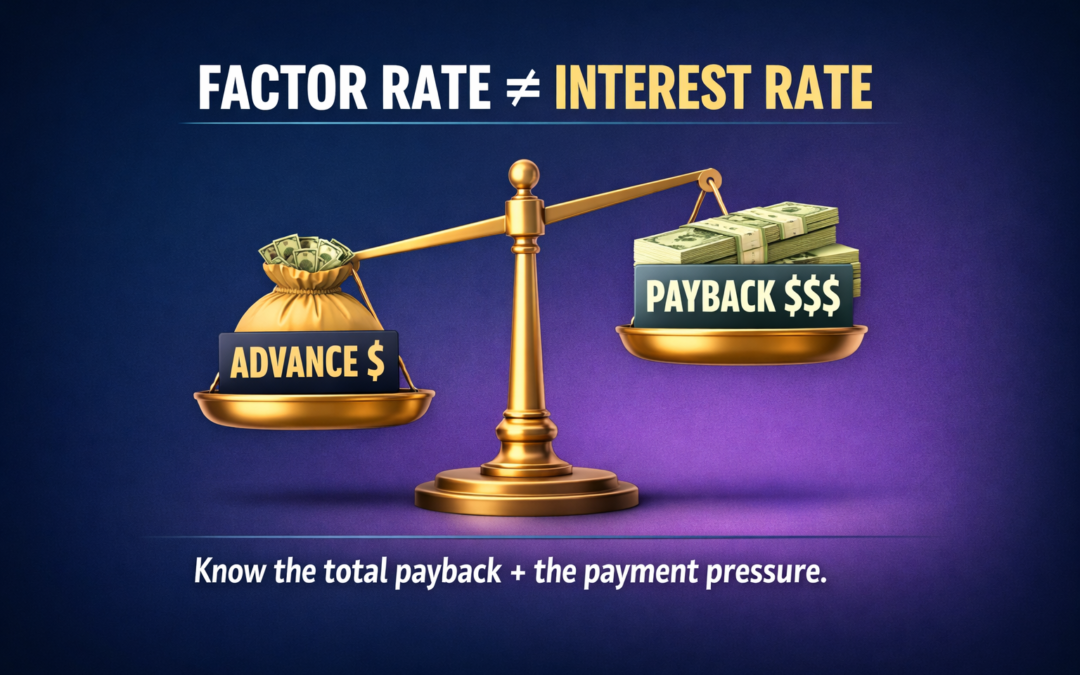
2) Factor rate (what drives your total payback)
Factor rates are usually shown like 1.20, 1.30, 1.40, etc.
It’s a multiplier that determines what you owe back.
Example:
- Advance: $50,000
- Factor rate: 1.35
- Total payback: $50,000 × 1.35 = $67,500
3) Total payback (the real price tag)
This is the number you should care about most. Ask plainly:
“What’s the total payback including all fees?”
4) Holdback or ACH repayment (how the money is taken)
- Holdback rate for Credit Card processing MCA = a percentage of daily card sales that goes to repayment.
- ACH withdrawals = a fixed amount drafted daily/weekly from your bank account (often less forgiving when sales dip).
5) Estimated term (how long repayment really takes)
MCAs offer “3–18 months,” but the actual timeline depends on sales volume, repayment method, and whether adjustments are allowed, like early payout discounts for example.
Holdback explained (and the cash-flow reality)
Holdback is usually described as “a percentage of sales,” and that’s the key benefit: when sales slow down, the payment typically scales down too because it’s tied to revenue.
In practice, it means your business is operating with less cash hitting the account on each processing day—so you still need to plan for the impact on cash flow.
Example: A 15% holdback on $5,000 in card sales means $750 is applied toward repayment that day.
If sales dip to $3,000, the holdback would generally be about $450 for that day.
That flexibility can be helpful during seasonal swings—as long as you understand the total payback and the timeline.
Reconciliation: the clause that can save you (if it’s real)
Some agreements allow reconciliation, meaning payments can be adjusted if sales drop.
Here’s the catch: “reconciliation” is only helpful when it’s:
- clearly written into the agreement
- available on a reasonable schedule
- not buried under impossible requirements
If someone tells you it exists, ask:
- Is it automatic or do I have to request it?
- How often can I request it?
- What proof is required?
- How long does approval take?
If it’s vague, assume it won’t help when you need it.
Stacking: where many businesses get trapped
Stacking is taking a second (or third) MCA before the first is under control.
This is where payment pressure becomes a spiral:
- more daily withdrawals
- less operating cash
- slower vendor payments
- higher NSF risk
- then “you need another advance to catch up”
If you’re already considering stacking, that’s usually a sign you need a different solution.
MCA red flags (simple, old-school common sense)
- They won’t state total payback clearly
- They pressure you to sign same-day
- The rep avoids explaining the contract terms
- They downplay daily/weekly payments
- They encourage stacking quickly
- The agreement’s “default” section is aggressive
And yes — regulators have gone after deceptive MCA-related conduct, which is another reason to read everything carefully.
Why disclosures matter (and why you should still do your own math)
Some states require commercial financing disclosures intended to help businesses comparison-shop, including for products like MCAs.
That’s helpful — but it doesn’t replace doing the basics:
- total payback
- payment frequency
- realistic term
- cash-flow impact if sales drop
When an MCA can make sense
An MCA is most defensible when it’s:
- short-term
- tied to a clear payoff plan
- used for something that quickly returns cash (inventory, a contract, time-sensitive opportunity)
- not being used to cover ongoing losses
When an MCA is usually the wrong move
Be careful if the MCA is being used for:
- long-term expansion with slow payoff
- plugging a monthly cash-flow leak
- consolidating debt without reducing payment pressure
- “we’ll figure it out later” plans
Fast money used to solve slow problems is how good businesses get squeezed.
The solution: MCA Offer Review (so you don’t guess)
This is where Diverse Merchant Solutions can help.
If you’re considering an MCA, our job is simple: we make the deal make sense on paper before it hits your bank account.
Here’s what we do in a quick offer review:
- Translate the offer into plain English (total payback, payment method, realistic timeline)
- Stress-test your cash flow (what happens if revenue drops 10–20%?)
- Compare alternatives where it makes sense (other funding structures, longer-term options, lower payment pressure)
What to send us for a clean review:
- the offer sheet (or screenshots)
- last 6 months bank statements (or a summary)
- your average monthly card sales / deposits
- any existing loans or advances
Call/Text: 800-343-5122
Or book a quick consult: (add your calendar link)
If your situation fits better with another structure, we’ll tell you that straight — because the goal isn’t “fast funding.” The goal is funding you can actually live with.